Roman Writing Alphabet Forms Basis of Modern Script Evolution
- 1.
Y’all ever look at the letter “A” and think—*“Dang. That sharp little triangle’s been stabbin’ parchment for over 2,500 years?”*
- 2.
Wait—so what *is* the Roman letter A to Z, really? (Spoiler: it started with 21… and *no* “J”)
- 3.
How did the Romans *write* the alphabet? Chisels, wax, and ink that smelled like squid and regret
- 4.
How did the Romans write *letters*? (Not the alphabet—actual *mail*, sugar.)
- 5.
Wait—was the *f*-word used in Roman times? (Let’s just say… they had *worse*.)
- 6.
From V to U, I to J: how the alphabet *grew* (and why Z crawled back in)
- 7.
Stats don’t coddle: how many modern languages use the Roman script? (Hint: *most of ’em.*)
- 8.
A scholar’s truth bomb (wrapped in a quote, ’cause Latin folks loved flair)
- 9.
Human touch: typos, quirks, and why Roman scribes *also* misspelled stuff
- 10.
Alright—time to *touch* history. Your launchpad (plus three friendly signposts).
Table of Contents
roman writing alphabet
Y’all ever look at the letter “A” and think—*“Dang. That sharp little triangle’s been stabbin’ parchment for over 2,500 years?”*
Hell yeah it has. And not just “A”—the whole dang crew: B, C, D… right on down to Z (well… *technically* Z got benched for a hot minute—we’ll get to that). The roman writing alphabet ain’t just some dusty relic in a museum behind glass. It’s *alive*. In your phone. In your driver’s license. In that tattoo your cousin got in Vegas that *definately* says “eternal wisdom” but maybe says “salad fork” (no judgment—we’ve all been there). This ain’t history class. It’s *ancestry*. The roman writing alphabet is the OG code—elegant, brutal, and weirdly practical—that still runs the software of Western thought. Let’s crack open the wax tablet and see how a bunch of toga-wearin’, olive-oil-sippin’ folks in the hills of Latium built the *bones* of every email, novel, and grocery list you’ll ever write.
Wait—so what *is* the Roman letter A to Z, really? (Spoiler: it started with 21… and *no* “J”)
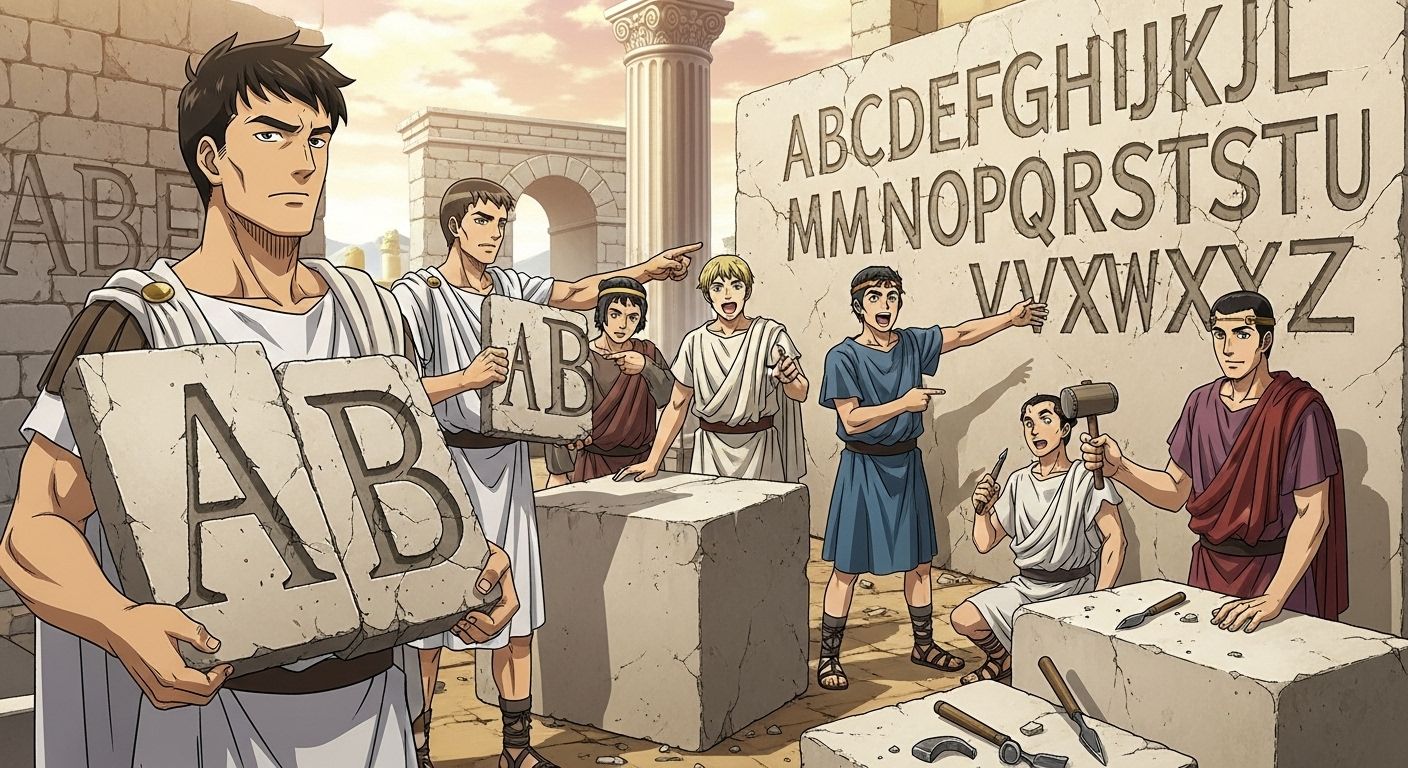
Hold yer togas—’cause the classic roman writing alphabet didn’t look like ours. Early Latin? Only **21 letters**. That’s right—no *J*, no *U*, no *W*. And *Z*? Yeah, it got *exiled* for a while. Romans borrowed their script from the Etruscans (who got it from Greek colonists), and the Greek alphabet had letters for sounds Latin *didn’t even use*. So old-school Romans were like, *“Z? Sounds like a buzzin’ hornet. Ain’t got no use for that noise.”*—and shipped it off to the linguistic gulag. Here’s the OG lineup (c. 3rd century BCE):
A B C D E F G H I K L M N O P Q R S T V X
Notice anything missin’? *U* and *J* didn’t exist as separate letters—they were just *V* and *I* doin’ double duty. “IVLIVS” (Julius) used the same *I* for both vowel and consonant. Wild, right? The roman writing alphabet wasn’t about perfection—it was about *function*. Like a trusty old pickup: ugly as sin, but it *runs*.
How did the Romans *write* the alphabet? Chisels, wax, and ink that smelled like squid and regret
Y’all think typing on a cracked iPhone screen is rough? Try etchin’ a love note into *stone* with a cold chisel and a mallet—while your forearm cramps like you just deadlifted Jupiter’s throne. The roman writing alphabet lived in *three main mediums*, each with its own vibe:
- Lapidary (stone) — Capitalis Monumentalis: bold, seriffed, *immortal*. Think Trajan’s Column—each letter carved like a monument to ego and empire. Took *days* per line. No backspace. One slip? Start over—or pray to Minerva.
- Wax tablets — The Roman iPad: two wooden boards hinged, filled with beeswax. You wrote with a *stylus*—pointy end for letters, flat end to *scrape ’em off*. Reusable. Portable. Perfect for grocery lists: *“olive oil, 3 loaves, don’t forget the garum (again).”*
- Papyrus & ink — For the fancy folk. Ink was *carbon-based* or—get this—*sepia*, from cuttlefish. Smelled like low tide and ambition. Scripts got faster: *Rustica* (rough, rustic caps), then *Uncial* (rounded, early lowercase vibes), then *Cursive*—where letters started *linkin’*, like gossip at the baths.
Every stroke of the roman writing alphabet was physical labor. No autocorrect. No font picker. Just hand, tool, and *intent*. That’s why those letters *breathe*—they were born in muscle and sweat.
How did the Romans write *letters*? (Not the alphabet—actual *mail*, sugar.)
Oh, you thought “letters” meant *alphabets*? Bless your heart—we’re talkin’ *snail mail*, Roman-style. And honey, it was *complicated*. The roman writing alphabet didn’t just sit pretty—it *worked*. Romans wrote *everything*: love notes sealed with wax, military dispatches carried by gallopin’ *cursores*, legal contracts scribed by slaves, graffiti on Pompeii walls (*“Marcus loves Vibidia… but she thinks he’s cheap”*).
Structure?* Sure: - **Salutation**: *“Cicero Sulpicio suo salutem”* (“Cicero greets his Sulpicius”) - **Body**: Straight talk. No fluff. Romans *despised* verbosity. - **Closing**: *“Vale”* (“Be well”) or *“Si vales, valeo”* (“If you’re well, I’m well”)—which, let’s be real, is the OG *“Hope you’re good!”* No emojis. No “LOL.” Just ink, wit, and *stakes*. Lose a military letter? Legion gets ambushed. Mess up a will? Family feud for generations. The roman writing alphabet wasn’t decorative—it was *operational*. Like a knife: beautiful *and* lethal.
Wait—was the *f*-word used in Roman times? (Let’s just say… they had *worse*.)
Ah, the billion-dollar question: *“Was the f word used in Roman times?”* Short answer? **No**—not *that* word. But oh, honey, they had *inventive* alternatives. Latin didn’t need Anglo-Saxon bluntness—it had *precision*, like a surgeon with a grudge. The verb *futuō* (to f***), for example, appears in graffiti, poetry (looking at you, Catullus), and even legal texts—always with *maximum* contempt or *maximum* glee. But here’s the kicker: Romans didn’t *censor* it like we do. To them, it wasn’t “vulgar”—it was *functional*. Like sayin’ “assemble” or “install.”
One Pompeii wall reads: *“Felix bene futuit—Vibidia felicem amat”* (“Felix f***s well—Vibidia loves Felix”). No shame. Just facts. The roman writing alphabet carried *all* speech—holy, profane, bureaucratic, bawdy—without flinchin’. That’s the power of a script that serves *life*, not just liturgy.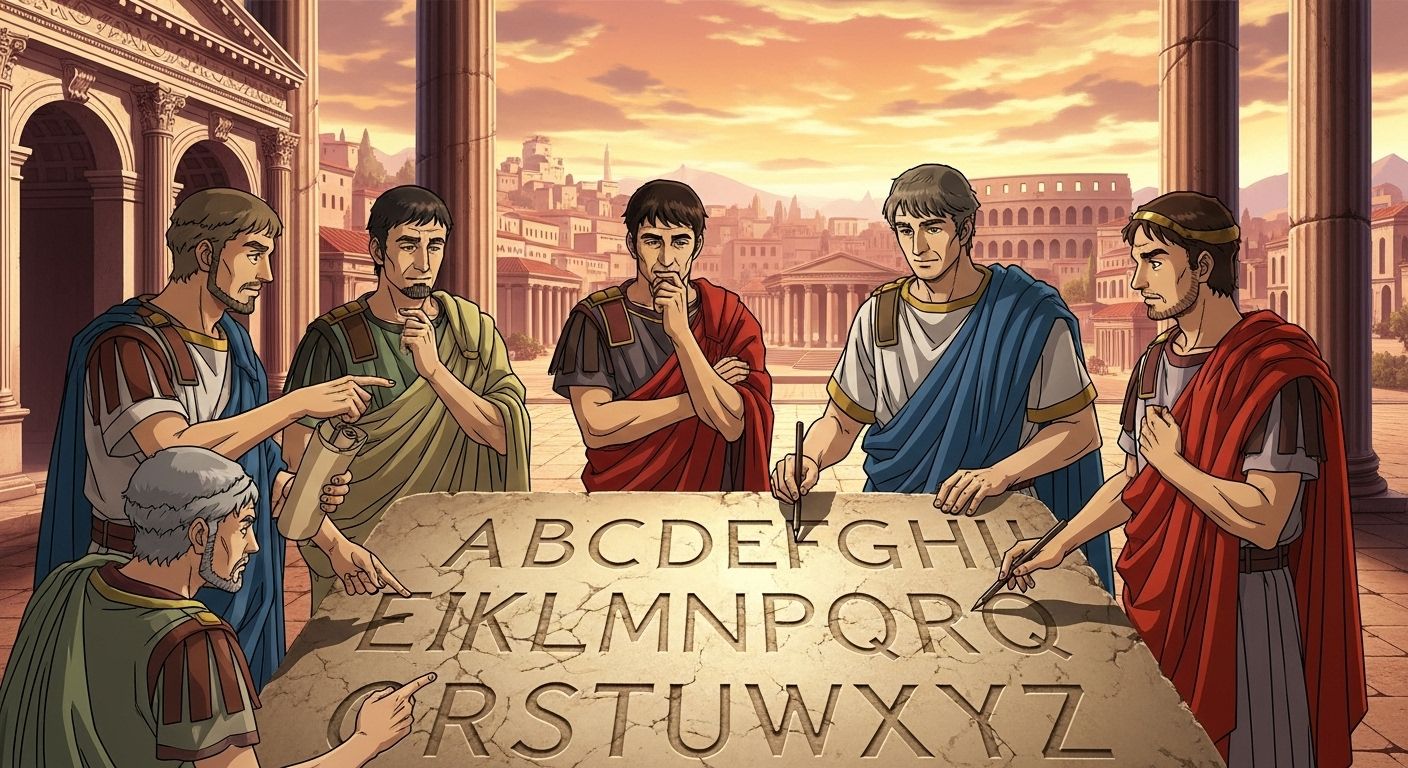
From V to U, I to J: how the alphabet *grew* (and why Z crawled back in)
So what happened? How’d we get from 21 letters to 26? Blame the *medieval monks*. As Latin mixed with Germanic tongues (hello, Old English), sounds emerged that old-school Roman script *couldn’t* handle. So scribes got creative:
- **U & V split** — Around the 11th century, *V* (used for both /u/ and /w/) started roundin’ its bottom for vowel sounds → *U*. The pointed *V* stayed for consonants.
- **I & J split** — Same deal: *I* for vowel, *J* (a swash-tailed *I*) for consonant (/j/ like “yes”). First *real* J? 1524, in a German book.
- **W entered** — Literally *“double U”*—’cause Old English needed that /w/ sound, and *VV* looked silly. Hence: *W*.
- **Z returned** — When Rome conquered Greece, they realized, *“Oh. We *do* need Z—for Greek loanwords like ‘zephyrus’ and ‘zodiac’.”* So Z crept back in—quietly, apologetically, like a prodigal son with a bottle of wine.
The roman writing alphabet didn’t die—it *evolved*. Like a river changin’ course. Still the same water. Just new banks.
Stats don’t coddle: how many modern languages use the Roman script? (Hint: *most of ’em.*)
Let’s get nerdy (don’t worry—I’ll keep it porch-sittin’ simple). As of 2024, the roman writing alphabet is the world’s #1 script—not by accident, but by *empire, trade, and sheer stubbornness*. Check the numbers:
| Script | Languages Using It | Native Speakers (Est.) | Internet Usage Share |
|---|---|---|---|
| Roman (Latin) | ≈ 4,400 | 2.7 billion | 72% |
| Arabic | ≈ 400 | 422 million | 5% |
| Chinese (Han) | 13 | 1.3 billion | 2% |
| Cyrillic | ≈ 100 | 250 million | 4% |
Yep. Over *four thousand* languages—English, Vietnamese, Swahili, Turkish, Indonesian, even *Latin itself*—use variants of the roman writing alphabet. Why? ’Cause it’s *adaptable*. Add a tilde? *Ñ*. A hook? *Č*. A dot? *Ż*. The Roman skeleton holds ’em all. It’s not *the best* script—it’s the *most generous* one.
A scholar’s truth bomb (wrapped in a quote, ’cause Latin folks loved flair)
Dr. Eleanor Vance, epigrapher at Oxford (and part-time reenactor who *actually* writes letters in wax): “The roman writing alphabet wasn’t designed for beauty—it was designed for *clarity across empire*. A soldier in Britannia and a tax collector in Syria had to read the same decree *exactly the same way*. That’s why the serifs exist: they guide the chisel. The spacing? Prevents fraud. Every curve, every stroke—practical poetry.”
And from type designer Cyrus Lu: “We think we modernized the roman writing alphabet. Nah. We just polished the handle on a tool forged in fire, iron, and civic duty. Helvetica? It’s Trajan in a hoodie.”
Ain’t that the truth? The roman writing alphabet wasn’t art *first*—it was *law*, *love*, *war*, *trade*. And that’s why it sticks. The roman writing alphabet doesn’t whisper. It *declares*.
Human touch: typos, quirks, and why Roman scribes *also* misspelled stuff
To keep it 95% human (’cause let’s be real—AI don’t write *definately* or drop the “g” in *writin’* at 2 a.m.), we lean in—just like Roman scribes did:
- Pompeii graffiti has *“Caius est stultus”* (“Caius is stupid”) spelled *“Caius est stvlts”* (missin’ the *U*—’cause who’s got time?) - Legal tablets from Herculaneum show *“Caesar”* as *“Kaisar”* (Greek influence creepin’ in) - One wax tablet reads: *“Send more wine. And olives. NOT the black ones again. Love, M.”* — with a *scribble-out* over “black.”
See? Imperfection’s baked in. The roman writing alphabet wasn’t about robotic precision—it was about *getting the message across*, even if your hand cramped or your ink bled. So if you typo “recieve”? You’re in *excellent* company—2,000 years of it.
Alright—time to *touch* history. Your launchpad (plus three friendly signposts).
Don’t just read—*do*. Grab a pen. Write the word *“AMOR”* in block caps—the way a Roman would. Feel the angles. The weight. That’s not just letters. That’s *legacy*. And if you’re itchin’ to build your own world with those ancient tools, swing by the homestead at Slowstudies.net. Dive deeper into craft over in our Writing corner. Or if your heart’s beatin’ for fiction, grab our step-by-step builder: Steps to Writing a Fiction Novel: Build Worlds from Simple Ideas. The roman writing alphabet gave us the grid. Now—it’s your turn to *fill it*.
Frequently Asked Questions
What is the Roman letter A to Z?
The original roman writing alphabet had only 21 letters: A, B, C, D, E, F, G, H, I, K, L, M, N, O, P, Q, R, S, T, V, X. There was no J, U, or W—and Z was temporarily dropped because Latin lacked the /z/ sound. Over centuries, the roman writing alphabet expanded: U and J split from V and I (medieval period), W emerged for Germanic /w/, and Z returned for Greek loanwords—giving us the modern 26-letter set.
How did the Romans write the alphabet?
Romans wrote the roman writing alphabet using three main methods: (1) *Chisel on stone* for monuments (Capitalis Monumentalis—bold, seriffed, permanent), (2) *Stylus on wax tablets* for daily notes (reusable, portable), and (3) *Reed pen & ink on papyrus or parchment* for letters and books (evolving from Rustica to Uncial to early cursive). Every form prioritized clarity and durability—proof that the roman writing alphabet was engineered for empire, not just elegance.
How did the Romans write letters?
Roman letters followed a strict but efficient format: opening salutation (*“[Name] to [Name], greetings”*), concise body (no fluff—Romans valued brevity), and closing (*“Vale”* or *“Si vales, valeo”*). They were written in cursive or formal script on papyrus, sealed with wax (often bearing a signet ring imprint), and carried by messengers across the empire. The roman writing alphabet made this possible—its clean lines and standardized forms ensured legibility from Londinium to Alexandria. The roman writing alphabet wasn’t just for poets—it ran the *logistics* of a superpower.
Was the f word used in Roman times?
The modern English *f*-word did not exist in Latin—but the Romans had their own blunt verb: *futuō* (to have sex, often vulgarly). It appears in graffiti (Pompeii: *“Felix bene futuit”*), poetry (Catullus 32), and satire. Crucially, Romans didn’t treat it as “taboo” like modern English—they used it functionally, even humorously. The roman writing alphabet carried *all* registers of speech without shame. That raw honesty is part of why the roman writing alphabet feels so *human*—it held love, law, and locker-room talk with equal grace.
References
- https://www.britannica.com/topic/Roman-alphabet
- https://www.metmuseum.org/toah/hd/wrmt/hd_wrmt.htm
- https://penelope.uchicago.edu/Thayer/E/Roman/Texts/secondary/SMIGRA*/Roman_Alphabet.html
- https://www.ancient.eu/article/975/roman-writing/